
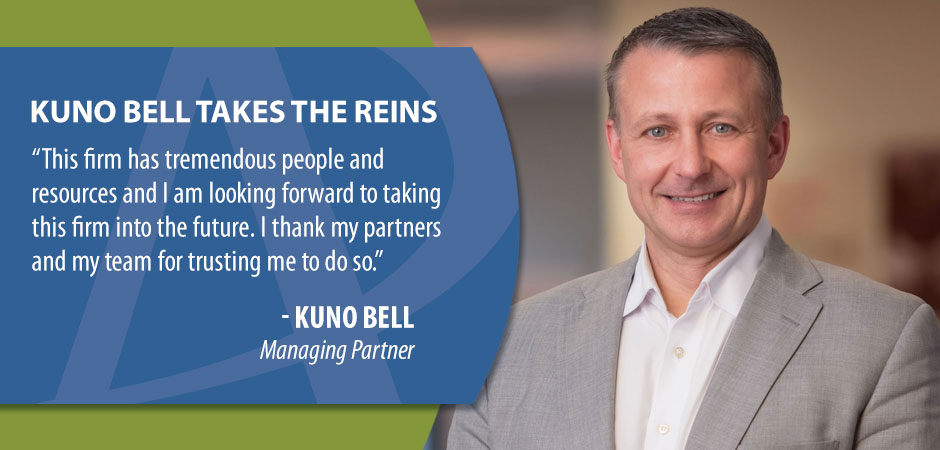
Pease Bell CPAs, a Cleveland-based CPA firm serving clients across Ohio, New York, New Jersey, and California for more than two decades, appointed Kuno Bell, CPA, J.D., as its new managing partner effective June 1, 2019. The CPA firm managing partner transition represents a carefully planned leadership succession that positions the firm for continued growth while honoring its founding legacy. For readers weighing how succession affects them, this article answers one central question: what makes a CPA firm leadership transition succeed for clients and staff?
Founder and former managing partner Joe Pease stepped out of the day-to-day leadership role and onto the Executive Board, where he remains Chairman. The move reflects a broader trend in accounting firm succession planning, where founders deliberately develop internal talent to ensure continuity, client retention, and strategic momentum.
Why This CPA Firm Leadership Transition Matters
Leadership transitions at CPA firms carry significant weight for clients, staff, and the broader professional services market. A poorly managed succession can disrupt client relationships, erode institutional knowledge, and slow firm growth. The Pease Bell approach, promoting from within after nearly three decades of development, demonstrates a model that other accounting firms can study.
Kuno Bell joined the firm as an intern in 1990 while completing his bachelor’s degree in accounting at Cleveland State University. He continued his education while employed at Pease, earning a Juris Doctor degree cum laude from Case Western Reserve University School of Law. His dual credentials as both a CPA and an attorney give him a distinctive vantage point on tax strategy, regulatory compliance, and client advisory work.
“We are excited to have Kuno assume the role of managing partner, and continue the memorable journey we began decades ago,” said Joe Pease. “Kuno aspired to be in this role from the time of his interview way back as an intern, and now it has become a reality.”
Continuity of this kind also protects the technical foundation a firm builds over years. Clients who rely on a firm for tax advisory services and complex compliance work depend on stable leadership to keep specialized teams intact through a handoff.
Kuno Bell’s Role in Building the Firm’s Growth
Before stepping into the managing partner role, Bell directed the Tax Department at Pease Bell and led the team’s growth efforts in that practice area. His key areas of expertise span three high-demand industries: manufacturing, real estate, and skilled nursing and long-term care.
Bell is credited with originating and growing the healthcare niche at Pease Bell, a practice area that now accounts for a substantial share of the firm’s total revenue. Building a specialized niche of that scale requires not just technical knowledge but also deep client relationships, referral network development, and an understanding of industry-specific regulations such as HUD Section 232 audit requirements and Medicare cost reporting.
The skilled nursing sector in particular demands specialized service, from HUD program compliance to detailed Medicare cost report preparation. The U.S. Department of Housing and Urban Development administers the Section 232 program, which finances residential care facilities and carries specific audit and reporting obligations for owners and operators. Details on that program are published by HUD’s Office of Residential Care Facilities.
His track record of revenue generation and practice area development made him the natural successor for the CPA firm managing partner position. Firms that promote leaders with demonstrated business-building capabilities, rather than purely technical skills, tend to sustain growth more effectively through transitions. Bell’s ability to combine technical tax expertise with strategic business development and client relationship management exemplifies the well-rounded leadership profile that modern accounting firms increasingly seek in their next managing partner.
Accounting Firm Succession Planning: Lessons From the Pease Bell Model
Accounting firm succession planning is one of the most critical challenges facing the profession. The AICPA has long highlighted that a wave of partner retirements creates urgency for firms of all sizes to develop next-generation leaders. Practical guidance on this topic is available through the AICPA’s guidance on succession transitions. The Pease Bell transition offers several takeaways for firms managing this process.
First, long-term development works. Bell spent 29 years at the firm before assuming the top role. That depth of tenure meant he understood every dimension of the business, from client service delivery to operational management to strategic positioning within CPAmerica, one of the largest associations of independent accounting firms in the world.
Second, the transition preserved client confidence. By keeping Joe Pease on the Executive Board as Chairman, the firm maintained visible continuity. Clients who had built relationships with Pease could be reassured that his oversight and institutional knowledge remained accessible, even as day-to-day leadership shifted.
Third, the move was forward-looking. At 62, Pease recognized the right moment to hand over the reins to the next generation. Rather than waiting until retirement forced the issue, he chose a proactive timeline that gave Bell room to lead while Pease remained available as a resource.
“This firm has tremendous people and resources and I am looking forward to taking this firm into the future,” said Bell. “I thank my partners and my team for trusting me to do so.”
A succession plan also reduces a real business risk. A sudden, unplanned departure of firm leadership can trigger client attrition and staff uncertainty, which is why proactive transitions are increasingly treated as a core element of firm strategy rather than an afterthought.
About Pease Bell CPAs: A Cleveland CPA Firm With National Reach
Pease Bell CPAs operates as a full-service CPA firm headquartered in Cleveland, Ohio. The firm provides tax advisory services, audit and assurance, accounting, and business consulting to clients across multiple states, including New York, New Jersey, and California.
The firm’s industry specializations include manufacturing, real estate, and skilled nursing and long-term care. Under its CPAmerica membership, Pease Bell has access to a national network of independent accounting firms, giving it resources and capabilities that extend well beyond its Cleveland base.
Bell holds a bachelor’s degree in accounting from Cleveland State University and a Juris Doctor degree from Case Western Reserve University School of Law. He is a member of the American Mensa society and resides in Sheffield Lake, Ohio, with his family.
What a Managing Partner Does at a CPA Firm
The managing partner at a CPA firm is responsible for the overall strategic direction, business development, and operational management of the practice. Unlike a technical partner who focuses primarily on client engagements, the managing partner sets firm-wide priorities, manages partner relationships, oversees talent development, and drives revenue growth.
In Bell’s case, his background leading the Tax Department and building the healthcare practice gives him hands-on experience in the operational side of firm management. His legal training also positions him to handle complex regulatory environments and advise clients on matters that intersect tax, law, and business strategy. That intersection matters because CPAs operate under licensing and ethics rules set by state boards and reinforced by professional standards, which the AICPA Code of Professional Conduct codifies in detail.
The role requires balancing short-term client service excellence with long-term strategic investments in people, technology, and market positioning. For a firm like Pease Bell, with multi-state operations and deep industry niches, the managing partner must also coordinate across geographic and practice-area boundaries to maintain consistent service quality.
Frequently Asked Questions
Who is the managing partner of Pease Bell CPAs?
Kuno Bell, CPA, J.D., serves as the managing partner of Pease Bell CPAs. He was appointed to the role effective June 1, 2019, after spending 29 years at the firm, including leadership of the Tax Department and development of the healthcare practice niche.
What does a managing partner do at a CPA firm?
A CPA firm managing partner oversees the firm’s strategic direction, business development, and day-to-day operations. The role involves setting firm-wide priorities, managing partner relationships, driving revenue growth, and ensuring consistent client service quality across all practice areas.
How do accounting firms plan for leadership succession?
Accounting firm succession planning typically involves identifying high-potential partners early, providing them with progressively greater leadership responsibilities, and creating a structured timeline for the transition. Successful plans also maintain continuity by keeping outgoing leaders in advisory or board roles during the handoff period.
What industries does Pease Bell CPAs specialize in?
Pease Bell CPAs specializes in manufacturing, real estate, and skilled nursing and long-term care. The healthcare practice, which Bell originated and grew, represents a substantial share of the firm’s total revenue.
Where is Pease Bell CPAs located?
Pease Bell CPAs is headquartered in Cleveland, Ohio, and serves clients across Ohio, New York, New Jersey, and California. The firm is a member of CPAmerica, one of the largest associations of independent accounting firms in the world.
Why is CPA firm leadership transition important for clients?
A well-managed CPA firm leadership transition protects client relationships, preserves institutional knowledge, and ensures uninterrupted service. Clients benefit when firms plan transitions proactively rather than reacting to sudden departures, because it maintains continuity in the advisory team and strategic direction.